
Introduction
Sales teams often spend a large portion of their time on repetitive tasks such as identifying potential leads, researching prospects, sending outreach emails, and following up on responses. These early-stage activities are typically handled by Sales Development Representatives (SDRs), whose role is to qualify prospects and schedule conversations for the main sales team.
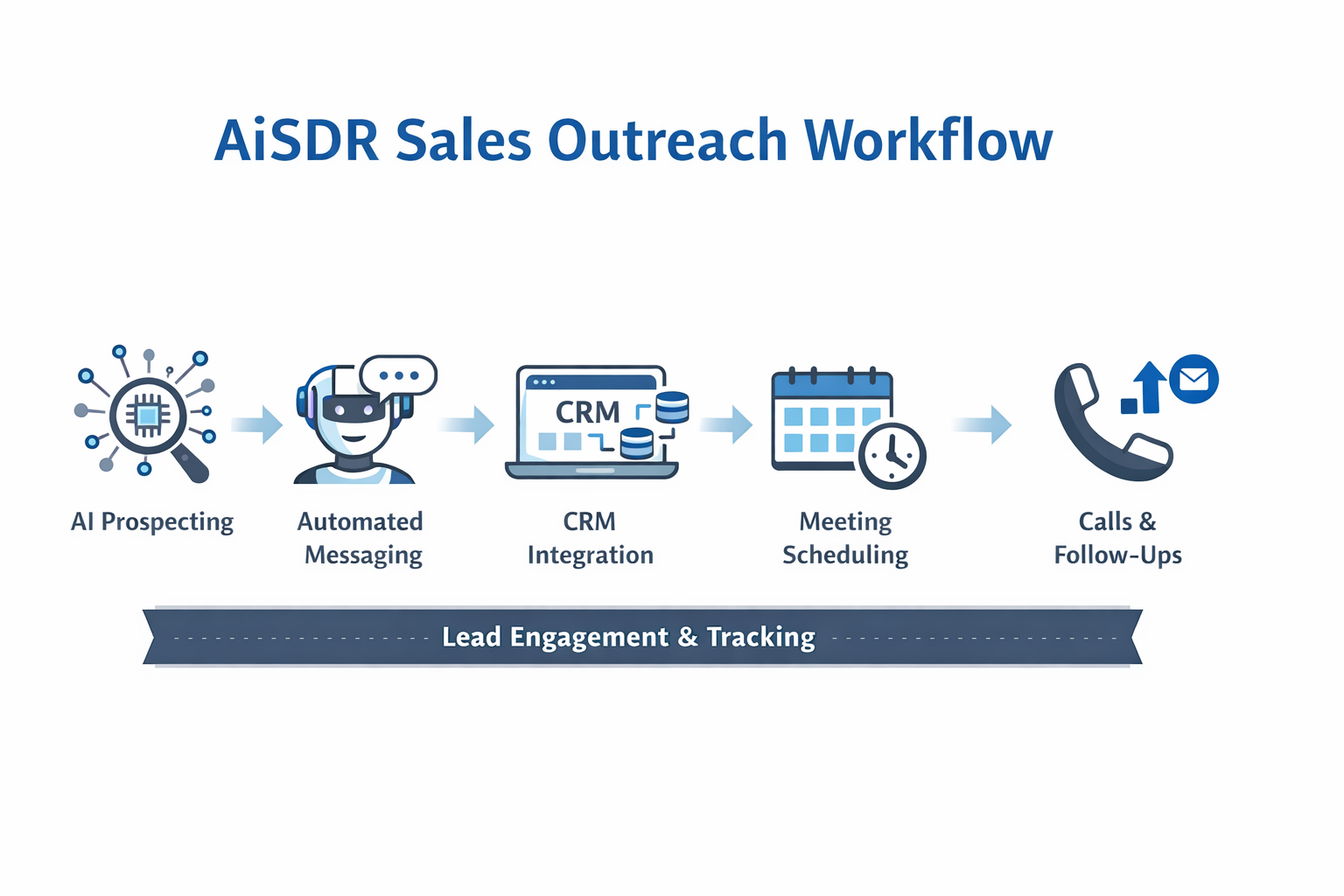
As digital sales tools evolve, many organizations are exploring automation to handle repetitive prospecting tasks. One example of this approach is AiSDR, a platform designed to automate several functions traditionally performed by SDRs, including lead discovery, personalized messaging, and follow-up communication.
This article explains how AiSDR works, its common features, possible advantages, and situations where it may or may not be suitable.
What Is AiSDR?
AiSDR is an AI-based sales automation platform designed to assist businesses with outbound prospecting and lead qualification. The system functions as a virtual Sales Development Representative that identifies potential prospects, creates personalized outreach messages, and manages follow-up conversations automatically.
The platform uses artificial intelligence and large language models to analyze lead information and generate contextual communication with potential customers. Instead of manually writing outreach emails or researching prospects, users can configure campaigns and allow the system to automate the early stages of the sales pipeline.
The goal is to reduce the amount of manual work required to identify and engage potential buyers while allowing human sales representatives to focus on closing deals and building relationships.
Key Features Explained
Automated Prospect Identification
The system can identify potential leads based on signals such as company activity, industry trends, or online information. It monitors publicly available data sources to detect potential buying intent or relevant business changes that may indicate a prospect is ready for outreach.
AI-Generated Personalized Messaging
After identifying a prospect, the platform researches available information such as company details or social activity and uses it to generate personalized outreach messages. These messages are designed to appear context-aware rather than generic templates.
Multi-Channel Outreach Sequences
AiSDR supports communication across different outreach channels such as email and professional networking platforms. Automated sequences can be configured to send follow-ups based on how a prospect responds or interacts with the messages.
Automated Response Handling
The AI system can respond to common questions, process replies, and filter interested prospects before forwarding them to the human sales team. This helps reduce the number of low-quality leads reaching account executives.
Meeting Scheduling and Lead Qualification
When a prospect expresses interest, the platform can automatically qualify the lead based on predefined criteria and schedule meetings with the sales team. This creates a continuous pipeline of conversations without requiring manual follow-up.
CRM Integration
AiSDR integrates with popular customer relationship management platforms such as HubSpot and Salesforce. These integrations allow the tool to sync contact data, track outreach activity, and update lead status within existing sales workflows.
Common Use Cases
Automated Outbound Sales Prospecting
Companies use AiSDR to automate cold outreach campaigns that would otherwise require manual research and message writing.
Lead Qualification Before Sales Calls
The system can analyze replies and determine whether a prospect fits the ideal customer profile before a salesperson spends time on a call.
Follow-Up Management
Automated follow-ups help ensure that potential leads do not get lost due to delayed responses or missed communication.
Supporting Small or Growing Sales Teams
Startups or small teams sometimes use AI-based sales assistants to manage prospecting activities while keeping human resources focused on negotiations and closing.
Potential Advantages
Reduced Manual Workload
Tasks such as researching leads, drafting emails, and managing follow-ups can be automated, reducing administrative workload for sales teams.
Continuous Outreach
Unlike manual prospecting, automated systems can run outreach campaigns continuously without interruption.
Consistent Follow-Up
AI systems can maintain consistent follow-up schedules, which is often difficult for human sales teams managing multiple leads simultaneously.
Faster Lead Processing
Automation allows companies to contact and qualify large numbers of prospects quickly compared with manual processes.
Limitations and Considerations
Dependence on Data Quality
If lead data or targeting parameters are inaccurate, automated outreach campaigns may reach irrelevant prospects.
Limited Human Context
AI-generated messages may not fully capture the nuance or relationship-building ability that experienced sales representatives bring to conversations.
Risk of Generic Communication
Without careful configuration and oversight, automated outreach can become repetitive or impersonal.
Need for Human Oversight
Most organizations still rely on human sales representatives for complex negotiations, strategic conversations, and relationship development.
Who Should Consider AiSDR
AiSDR may be relevant for:
- Sales teams running large outbound prospecting campaigns
- Startups seeking automation for early-stage lead generation
- Companies that want to reduce time spent on manual prospect research
- Marketing teams experimenting with automated sales engagement
Who May Want to Avoid It
AiSDR may be less suitable for:
- Businesses that rely heavily on relationship-driven sales
- Companies with very niche or complex target markets
- Teams that prefer fully manual outreach strategies
- Organizations without clear customer targeting criteria
Comparison With Similar Tools
AiSDR belongs to a broader category of AI-driven sales engagement platforms that automate prospecting and communication. Many tools in this category provide similar functions such as email automation, lead scoring, CRM integration, and AI-generated messaging.
The main differences between platforms often relate to:
- Data sources used for lead discovery
- depth of AI personalization
- supported outreach channels
- integration with existing sales infrastructure
Organizations typically evaluate these tools based on workflow compatibility, compliance considerations, and how well the automation fits their existing sales process.
Final Educational Summary
AiSDR represents a growing category of AI-based sales tools designed to automate the repetitive tasks associated with sales development. By combining lead discovery, message generation, automated follow-ups, and lead qualification, the platform aims to support sales teams during the early stages of the customer acquisition process.
While such tools can improve efficiency in outreach campaigns, they are generally most effective when used alongside human sales professionals who manage complex conversations, relationship building, and deal negotiations.
Disclosure
This article is an independent educational overview of a software platform. It is not sponsored content and does not promote or recommend the purchase of any product or service. The purpose is to explain how the technology works, its common use cases, and the considerations organizations may evaluate before using similar tools.
