
Introduction
Digital communication has transformed how organizations interact with audiences. Among the various channels available—social media, paid advertising, and search engine optimization—email remains one of the most established forms of direct digital outreach. Despite its longevity, email marketing has evolved significantly. Modern platforms now integrate automation, behavioral segmentation, analytics dashboards, and customer journey orchestration tools.
The rapid growth of digital contact databases and increasing expectations for personalization have led to the development of advanced email marketing software. These systems are designed to manage subscriber data, automate campaigns, and analyze engagement metrics across diverse customer segments. Within this landscape, Campaigner operates as a marketing automation and email campaign management platform focused on structured outreach and workflow-driven messaging.
Understanding how such tools function requires examining not only their features but also their role within broader digital marketing infrastructure.
What Is Campaigner?
Campaigner is an email marketing and marketing automation platform designed to help businesses create, manage, automate, and analyze email campaigns. It falls within the broader category of customer engagement software and is commonly used alongside customer relationship management (CRM) systems and e-commerce platforms.
As a cloud-based solution, Campaigner enables users to:
- Design email newsletters and promotional campaigns
- Segment contact lists based on behavioral and demographic data
- Automate multi-step email workflows
- Monitor performance metrics such as open rates and click-through rates
- Integrate with third-party systems for data synchronization
Within the digital marketing software ecosystem, Campaigner can be classified as:
- Email campaign management software
- Marketing automation software
- Subscriber list management platform
- Customer engagement analytics tool
Its positioning emphasizes structured automation, compliance management, and scalable campaign deployment.
Key Features Explained
A comprehensive understanding of Campaigner requires examining its core functionalities in detail.
Email Campaign Builder
Campaigner provides tools for designing email campaigns using pre-designed templates and customizable layouts. Users can create HTML-based emails or adapt drag-and-drop editors to structure visual content. The system supports personalization tokens, allowing dynamic insertion of subscriber data such as first name or purchase history.
Marketing Automation Workflows
Automation is central to contemporary email marketing platforms. Campaigner includes workflow builders that allow users to define triggers, conditions, and timed sequences. These workflows may activate based on:
- Subscription events
- Purchase activity
- Website behavior
- Email engagement patterns
Automation sequences can include branching logic, enabling different message paths depending on recipient actions.
Audience Segmentation Tools
Effective email marketing relies on accurate audience segmentation. Campaigner enables segmentation using criteria such as:
- Geographic location
- Purchase history
- Engagement level
- Subscription source
- Custom tags and fields
Segmentation supports targeted messaging, which is often associated with improved engagement metrics.
A/B Testing Capabilities
Campaigner includes split-testing features that allow users to test subject lines, email content variations, or send times. A/B testing contributes to data-informed campaign adjustments by comparing engagement performance between controlled variations.
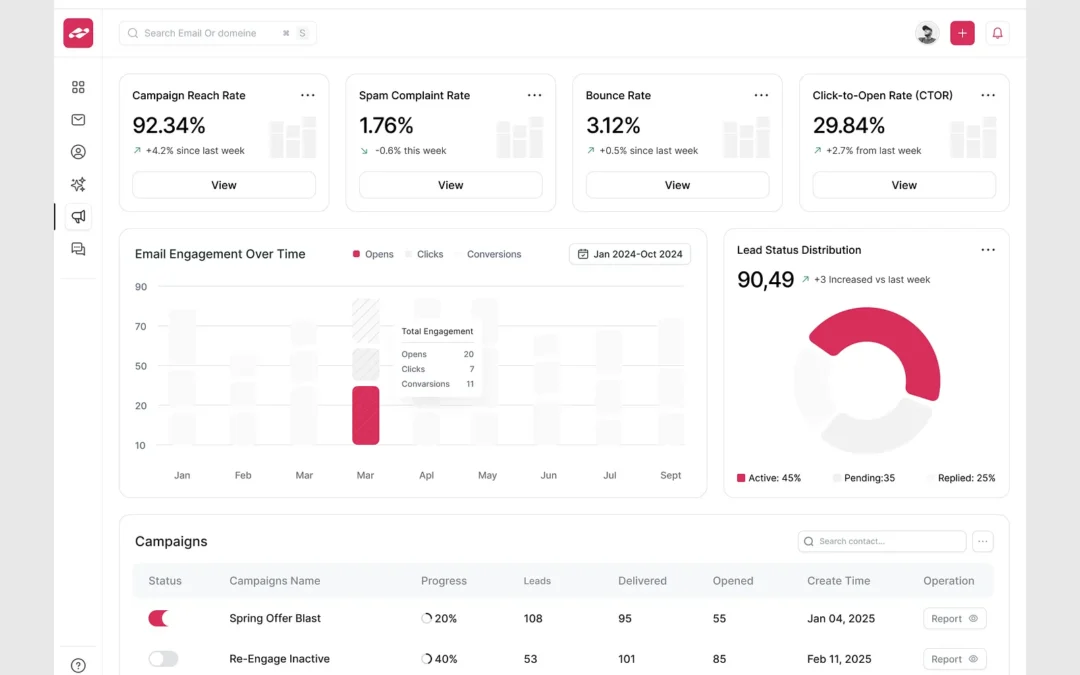
Analytics and Reporting Dashboard
The platform provides reporting tools that measure:
- Open rates
- Click-through rates
- Bounce rates
- Unsubscribe rates
- Conversion tracking (when integrated)
These metrics are essential for evaluating campaign performance and identifying trends across subscriber segments.
Compliance and Deliverability Management
Email marketing software must adhere to regulations such as CAN-SPAM and GDPR. Campaigner incorporates compliance features including:
- Automated unsubscribe handling
- Permission-based list management
- Spam compliance monitoring
- Deliverability reporting
Such tools help organizations maintain legal alignment and protect sender reputation.
Third-Party Integrations
Campaigner supports integrations with CRM systems, e-commerce platforms, and other digital marketing tools. These integrations enable data synchronization and support cross-channel marketing strategies.
Common Use Cases
Email marketing platforms serve multiple operational needs across industries. Campaigner is typically used in the following contexts:
E-commerce Customer Retention
Online retailers often deploy automated email sequences for:
- Abandoned cart reminders
- Post-purchase follow-ups
- Re-engagement campaigns
- Seasonal promotions
Segmentation based on purchasing behavior enables targeted offers without manual list management.
Lead Nurturing for Service Businesses
Professional services firms may use Campaigner to develop structured lead-nurturing workflows. Automated educational sequences can introduce prospects to resources over time, aligning messaging with different stages of the buyer journey.
Event Promotion and Registration Management
Organizations hosting webinars or conferences can automate:
- Event invitations
- Reminder emails
- Post-event follow-ups
- Feedback requests
Campaign analytics help track engagement levels across attendee segments.
Newsletter Publishing
Editorial teams and membership organizations often rely on recurring email newsletters. Campaigner supports scheduled distribution, subscriber segmentation, and engagement reporting.
Customer Lifecycle Automation
Businesses with subscription models may use automation tools to manage onboarding, renewal reminders, and churn prevention messaging.
Potential Advantages
While performance outcomes vary by implementation, several structural advantages are associated with Campaigner’s feature set.
Structured Automation Design
The workflow builder allows multi-step automation sequences with conditional branching. For organizations managing large subscriber databases, this reduces the need for manual campaign scheduling.
Scalable Subscriber Management
Campaigner supports large contact databases, making it relevant for growing organizations that require scalable email marketing infrastructure.
Detailed Engagement Metrics
Access to granular performance data enables teams to evaluate email effectiveness across audience segments. This supports iterative optimization based on measurable outcomes.
Compliance Infrastructure
Built-in permission management and unsubscribe systems reduce regulatory risk, particularly for organizations operating across multiple jurisdictions.
Integration Flexibility
Compatibility with CRM and e-commerce systems supports unified marketing data environments.
Limitations & Considerations
Despite its capabilities, Campaigner may not align with every organization’s operational model.
Learning Curve for Advanced Automation
While basic email campaigns are relatively straightforward, complex automation workflows may require strategic planning and technical familiarity. Smaller teams without dedicated marketing staff may find advanced configurations time-intensive.
Cost Considerations at Scale
Pricing structures in email marketing platforms often scale with subscriber volume and feature access. Organizations with rapidly expanding databases should evaluate long-term cost projections.
Template Customization Constraints
Although customizable, some pre-built templates may require HTML knowledge for advanced modifications. Users seeking complete design freedom may need additional design expertise.
Dependence on Data Quality
Automation performance depends heavily on accurate contact data. Inconsistent tagging or segmentation errors can reduce targeting precision.
Deliverability Influenced by External Factors
Even with deliverability monitoring, inbox placement is affected by sender reputation, domain configuration, and recipient behavior. No platform can entirely control these external variables.
Who Should Consider This Campaigner ?
Campaigner may be suitable for organizations that:
- Maintain moderate to large email subscriber lists
- Require multi-step marketing automation workflows
- Operate in e-commerce or subscription-based industries
- Need compliance-oriented email list management
- Value analytics-driven optimization
Marketing teams seeking structured workflow design and segmentation capabilities may find its feature set aligned with operational goals.
Who May Want to Avoid It?
Certain user groups may find alternative tools more appropriate.
- Small businesses requiring only basic newsletter functionality
- Organizations without resources to manage automation complexity
- Teams prioritizing omnichannel marketing beyond email-focused strategies
- Users seeking minimal configuration and simplified interfaces
In such cases, lighter email marketing tools or all-in-one marketing suites may provide a better fit.
Comparison With Similar Campaigner
Campaigner operates within a competitive email marketing software market that includes platforms such as Mailchimp, Constant Contact, and ActiveCampaign.
Campaigner vs Mailchimp
Mailchimp is widely recognized for its user-friendly interface and broad brand visibility. Campaigner, by comparison, places stronger emphasis on structured automation workflows and segmentation flexibility. Mailchimp often appeals to small businesses and startups, while Campaigner may suit teams seeking deeper automation logic.
Campaigner vs Constant Contact
Constant Contact historically targets small businesses and nonprofit organizations with simplified campaign tools. Campaigner provides more advanced automation branching and behavioral triggers, making it potentially more suitable for data-driven marketing strategies.
Campaigner vs ActiveCampaign
ActiveCampaign combines email marketing with CRM functionality and sales automation. Campaigner focuses more specifically on email campaign management and automation. Organizations requiring integrated sales pipelines may evaluate ActiveCampaign, while those prioritizing email-centric automation may consider Campaigner.
These distinctions are functional rather than hierarchical; suitability depends on operational priorities, technical capacity, and budget structure.
Final Educational Summary
Campaigner represents a structured approach to email marketing automation within the broader digital marketing software ecosystem. Its core strengths lie in segmentation capabilities, workflow-driven campaign design, compliance management, and performance analytics.
As with any marketing automation platform, effectiveness depends on implementation quality, data accuracy, and strategic alignment. Organizations evaluating email marketing software should consider:
- Database size and growth projections
- Required automation complexity
- Integration needs
- Compliance obligations
- Internal technical expertise
Email remains a central component of digital communication strategies. Platforms such as Campaigner illustrate how traditional email distribution has evolved into data-driven customer lifecycle management systems. A careful assessment of operational needs, technical resources, and long-term marketing objectives is essential before selecting any email campaign management solution.
Disclosure: This article is for educational and informational purposes only. Some links on this website may be affiliate links, but this does not influence our editorial content or evaluations.