
Introduction
Organizations across industries face a recurring challenge: understanding what users actually think about their products, services, and digital experiences. While analytics platforms provide behavioral data, they often fail to explain why users act in a certain way. This gap has led to the emergence of customer feedback and survey tools designed to collect direct input at various touchpoints.
Customer feedback platforms aim to bridge quantitative data with qualitative insights. They allow companies to gather opinions, measure satisfaction, and identify friction points in real time. These tools are increasingly integrated into websites, mobile applications, and email workflows to capture contextual feedback rather than relying solely on retrospective surveys.
Within this category, Survicate represents one such platform designed to collect and analyze user feedback through multiple channels. Its role reflects a broader shift toward continuous feedback loops rather than occasional surveys.
What Is Survicate?
Survicate is a customer feedback and survey software platform used to gather insights from users across digital environments. It belongs to the broader category of customer experience (CX) tools and survey platforms, with a focus on contextual data collection.
The platform enables organizations to create surveys that can be deployed on websites, within mobile apps, via email campaigns, or through integrations with other tools. Rather than functioning as a standalone survey builder, Survicate operates as part of a feedback ecosystem, where data collection, distribution, and analysis are interconnected.
Its primary objective is to help organizations understand user sentiment, satisfaction levels, and behavioral motivations without relying exclusively on indirect metrics such as page views or conversion rates.
Key Features Explained
Multi-Channel Survey Distribution
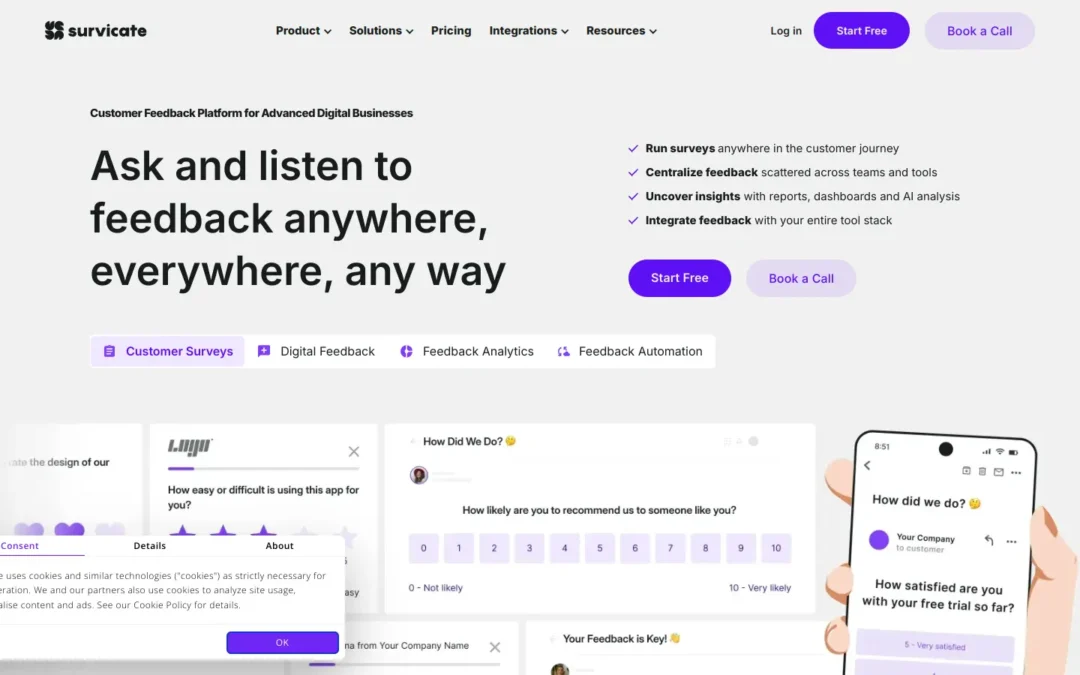
One defining aspect of Survicate is its ability to distribute surveys across multiple channels. Surveys can appear directly on websites as pop-ups, embedded forms, or slide-ins. They can also be sent through email or integrated into applications.
This multi-channel approach allows organizations to capture feedback at different stages of the user journey. For example, feedback can be collected immediately after a purchase, during onboarding, or when a user exits a page.
Survey Targeting and Triggering
Survicate includes targeting mechanisms that determine when and to whom surveys are shown. These triggers can be based on user behavior, such as time spent on a page, scroll depth, or specific actions taken within an application.
Targeting helps reduce survey fatigue by limiting exposure to relevant audiences. It also increases the likelihood of receiving meaningful responses, as users are prompted in context rather than randomly.
Question Types and Customization
The platform supports a variety of question formats, including multiple-choice, open-ended, rating scales, and Net Promoter Score (NPS) surveys. Customization options allow organizations to adjust survey design to match branding or interface requirements.
This flexibility enables different types of research, ranging from quick satisfaction checks to more detailed qualitative inquiries.
Integration Capabilities
Survicate integrates with several third-party tools commonly used in marketing, analytics, and customer relationship management (CRM). These integrations allow survey data to be synchronized with existing workflows.
For example, responses can be linked to user profiles or combined with behavioral analytics, providing a more comprehensive view of customer interactions.
Data Analysis and Reporting
Collected responses are organized within dashboards that allow for filtering, segmentation, and trend analysis. Users can examine patterns over time or compare responses across different audience segments.
While the platform provides built-in analytics, the depth of analysis often depends on how the data is exported or integrated with other systems.
Common Use Cases
Measuring Customer Satisfaction
Organizations frequently use Survicate to measure satisfaction levels through standardized metrics such as Customer Satisfaction Score (CSAT) and Net Promoter Score (NPS). These metrics provide a structured way to track user sentiment over time.
Product Feedback Collection
Product teams often rely on feedback tools to understand how users interact with features. Surveys can be triggered after feature usage to gather insights about usability, effectiveness, or areas needing improvement.
Website Experience Evaluation
Survicate can be used to assess how users perceive a website’s usability, content clarity, or navigation structure. Feedback collected at specific points helps identify friction areas that may not be visible through analytics alone.
User Research and Market Insights
Beyond immediate feedback, the platform can support broader research efforts. Organizations may use surveys to understand audience preferences, expectations, or demographic characteristics.
Customer Retention Analysis
Feedback tools can also play a role in identifying reasons behind churn or disengagement. Exit surveys or post-cancellation questionnaires can reveal underlying issues that contribute to customer loss.
Potential Advantages
Contextual Feedback Collection
One of the notable strengths of Survicate lies in its ability to gather feedback in context. Instead of asking users to recall past experiences, surveys are presented during or immediately after interactions. This approach can improve the accuracy of responses.
Flexibility Across Channels
The platform’s support for multiple distribution channels allows organizations to adapt feedback strategies based on their communication methods. Whether interacting through websites, emails, or applications, feedback collection can be aligned accordingly.
Integration with Existing Systems
Survicate’s integration capabilities enable it to function as part of a broader technology stack. Data collected from surveys can be connected with CRM systems, marketing platforms, or analytics tools, reducing data silos.
Scalable Survey Deployment
The platform supports both small-scale and large-scale deployments. Organizations can start with basic surveys and expand to more complex feedback programs without changing tools.
Real-Time Data Access
Responses are available in near real time, allowing teams to monitor trends and react to emerging issues. This immediacy can be particularly useful in dynamic environments where user sentiment may shift quickly.
Limitations & Considerations
Dependence on User Participation
Like all survey-based tools, Survicate relies on voluntary user responses. Response rates can vary significantly, and collected data may not always represent the entire user base.
Potential for Survey Fatigue
Frequent or poorly timed surveys can lead to user fatigue, reducing engagement and affecting data quality. Effective implementation requires careful planning of frequency and targeting.
Limited Depth Compared to Qualitative Research
While surveys provide valuable insights, they may not capture the full complexity of user experiences. In-depth qualitative methods such as interviews or usability testing may still be necessary for deeper understanding.
Integration Complexity
Although integrations are available, setting them up and maintaining data consistency can require technical expertise. Organizations with complex systems may need additional resources to manage these connections.
Data Interpretation Challenges
Interpreting survey data requires careful analysis. Misinterpretation of results or overreliance on quantitative metrics can lead to incorrect conclusions about user behavior.
Who Should Consider Survicate
Digital Product Teams
Teams responsible for websites or applications may find Survicate useful for understanding user interactions and identifying usability issues. Its ability to trigger surveys based on behavior aligns with product development workflows.
Marketing and Customer Experience Teams
Professionals focused on customer experience can use the platform to track satisfaction and gather feedback on campaigns, messaging, or user journeys.
SaaS Companies
Software-as-a-service providers often require continuous feedback to improve onboarding, feature adoption, and retention. Survicate’s integration with digital platforms makes it relevant in this context.
Small to Medium-Sized Businesses
Organizations with limited resources for extensive research may benefit from a tool that combines survey creation, distribution, and analysis in one platform.
Who May Want to Avoid It
Organizations Requiring Deep Qualitative Insights
Teams that rely heavily on detailed qualitative research methods may find survey tools insufficient on their own. In such cases, Survicate would need to be supplemented with additional research approaches.
Businesses with Low Digital Interaction
Companies that do not engage with users through digital channels may not fully utilize the platform’s capabilities. Offline-focused organizations may require alternative feedback methods.
Teams Without Data Analysis Capacity
If an organization lacks the resources or expertise to analyze survey data, the insights generated may not be effectively utilized. Interpretation plays a critical role in deriving value from feedback tools.
Comparison With Similar Tools
Survicate operates within a competitive landscape that includes several established survey and feedback platforms. While many tools offer overlapping features, differences often emerge in areas such as integration depth, targeting capabilities, and user interface design.
Compared to general-purpose survey tools, Survicate places greater emphasis on in-context feedback collection. This distinguishes it from platforms that primarily focus on standalone surveys distributed via email or links.
In contrast to enterprise-level customer experience platforms, Survicate may offer a more streamlined approach with fewer advanced analytics features. Larger platforms often include predictive analytics, journey mapping, and advanced segmentation, which may not be as prominent in simpler tools.
Additionally, some alternatives focus heavily on specific use cases, such as employee feedback or market research, whereas Survicate maintains a broader scope across customer feedback scenarios.
The choice between tools often depends on organizational needs, including scale, technical requirements, and the level of analytical depth required.
Final Educational Summary
Survicate represents a category of tools designed to address a fundamental challenge in digital environments: understanding user perspectives beyond behavioral data. By enabling organizations to collect feedback directly within user interactions, it provides a mechanism for capturing real-time insights.
Its multi-channel distribution, targeting capabilities, and integration options make it adaptable to various workflows. However, like all survey-based platforms, its effectiveness depends on thoughtful implementation, user participation, and careful data interpretation.
While it can support a wide range of feedback initiatives, it is not a complete substitute for more in-depth research methods. Instead, it functions as one component within a broader strategy for understanding and improving user experience.
Disclosure: This article is for educational and informational purposes only. Some links on this website may be affiliate links, but this does not influence our editorial content or evaluations.